
 Free Delivery & Return
 365-Day Returns
 10 Million Happy Customers
 500,000 Products in Stock


Mattresses


Bed Mattresses

Choosing a mattress affects how comfortable and supported you feel throughout the night, but terms such as foam, pocket springs, firmness and 7-zone support can make the choice confusing. This guide explains what these features mean and how to match them to your bed, sleeping position and everyday needs.
What type of mattress do you need?
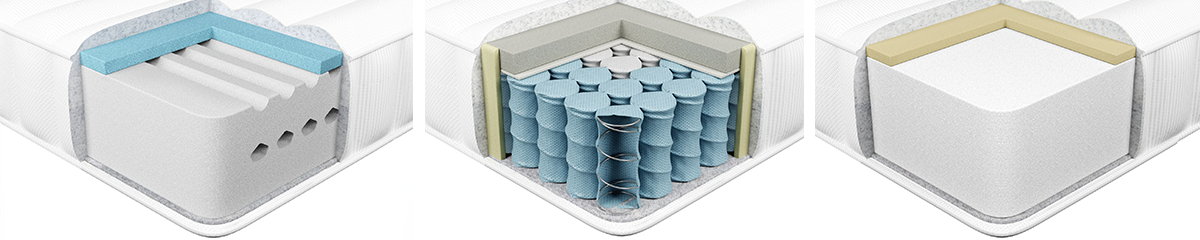
The filling and construction of a mattress affect how much you sink into it, how quickly it responds when you move and how much movement travels across the sleeping surface. If you are choosing a mattress for the first time, start by thinking about how you sleep and what you want to feel rather than choosing a material simply because it sounds more advanced.
- Foam: Foam mattresses provide consistent support across the sleeping surface and are often a practical choice for people who want a stable, cushioned feel. They can also limit movement transfer, making them worth considering if you share a bed and do not want to feel every movement from the other sleeper.
- Pocket springs: Each spring is enclosed in its own fabric pocket, allowing it to react independently to pressure. This creates a more responsive sleeping surface and can be suitable for sleepers who prefer a springier feel; the individual spring construction can also help reduce movement travelling from one side of the mattress to the other.
- Memory foam: Memory foam moulds around the body under pressure, creating a closer, more cushioned feel. It can be particularly suitable for side sleepers who want more cushioning around the shoulders and hips, and its ability to absorb movement makes it a useful option for couples who are easily disturbed by changes of position during the night.
What if you share a bed?
If you regularly wake when your partner turns over, look for a mattress designed to reduce motion transfer. Foam and memory foam generally absorb movement well, while pocket springs can also limit disturbance because the springs respond independently; the exact result depends on the complete mattress construction.
What mattress firmness do you need?
Firmness describes how soft or resistant a mattress feels when you lie on it. Your sleeping position is a useful starting point, but body weight, mattress construction and personal preference also affect how the same firmness feels to different people.
- Medium: Provides a balance between cushioning and resistance. It can suit combination sleepers who change position during the night and people who do not want either a very soft or very firm surface.
- Medium-firm: Offers more resistance while retaining some cushioning. It can be a useful starting point for back sleepers and people who prefer less sinkage around the body.
- Firm: Provides greater resistance and less sinkage. It can suit stomach sleepers and people who prefer a more solid sleeping surface.
Firmness is not the same as support
A firmer mattress is not automatically more supportive. Support describes how well the mattress holds the body, while firmness describes how hard or soft the sleeping surface feels.
Does your sleeping position affect mattress choice?
Your usual sleeping position changes where your body places pressure on the mattress. Use it as one factor when comparing firmness and construction rather than treating it as a strict rule.
Side sleepers
Allow room for shoulders and hips
A mattress with some cushioning allows the shoulders and hips to sink into the surface while the rest of the body remains supported. Memory foam and other cushioning constructions can be useful if you find firm surfaces uncomfortable around these pressure points.
Back sleepers
Balance cushioning and resistance
Back sleepers generally need a surface that supports the body without allowing excessive sinking around the hips. Medium and medium-firm mattresses can provide useful starting points for comparison.
Stomach sleepers
Limit excessive sinkage
A more resistant surface can help prevent the middle of the body from sinking too deeply into the mattress. Medium-firm and firm mattresses can therefore be useful options to compare.
What mattress size do you need?
The mattress dimensions should match the internal sleeping area specified for your bed frame. Room size also matters, particularly with wider mattresses, because you need enough space to move around the bed and use nearby furniture comfortably.
| Mattress size | Common use | What to consider |
|---|---|---|
| 80 x 200 cm | Compact single beds | Useful where bedroom floor space is limited. |
| 90 x 200 cm | Single sleeping | Provides additional width for one sleeper compared with an 80 cm mattress. |
| 120 x 200 cm | Larger single beds | Offers extra sleeping space for one person while taking up less room than a double mattress. |
| 140 x 200 cm | One sleeper wanting more room or compact sleeping for two | A common choice for smaller bedrooms where a wider sleeping area is preferred. |
| 160 x 200 cm | Two sleepers | Provides each sleeper with more personal space than a 140 cm mattress. |
| 180 x 200 cm | Two sleepers wanting additional space | Requires a larger bed frame and sufficient bedroom floor space. |
What is 7-zone design in mattresses?
A 7-zone mattress divides the sleeping surface into seven areas, each designed to provide a different level of support to a particular part of the body. Starting from the head and moving towards the feet, the zones cover the head and neck, shoulders, upper back, lower back, hips, legs and feet. The aim is to adapt the sleeping surface to the body's shape and distribute pressure more evenly, although the exact firmness and construction of each zone varies between mattresses.
Zone 1: Head and neck
Gentle support
The first zone provides support around the head and neck area. It is designed to create a stable transition between the pillow and the rest of the mattress.
Zone 2: Shoulders
Room for pressure points
The shoulder area usually needs more cushioning, particularly for side sleepers. A zone with greater flexibility can allow the shoulders to sink slightly into the mattress instead of creating concentrated pressure.
Zone 3: Upper back
Balanced support
The upper-back zone is designed to support the wider part of the torso while distributing body weight across the mattress. The aim is to provide a balanced transition between the shoulders and lower back.
Zone 4: Lower back
More stable support
The lower-back zone supports the narrower part of the torso and helps the mattress follow the body's natural shape. Its level of resistance is intended to provide stability without making the transition from the upper body to the hips feel abrupt.
Zone 5: Hips
Cushioning for a wider area
The hips are one of the wider and heavier areas of the body, so this zone can be designed to distribute pressure while allowing some cushioning. This can be particularly useful for side sleepers.
Zone 6: Legs
Balanced support towards the feet
The leg zone provides a transition from the heavier central areas of the body towards the lower end of the mattress. It is intended to maintain a consistent and comfortable level of support under the legs.
Zone 7: Feet
A comfortable finish
The final zone supports the feet and completes the transition across the sleeping surface. It generally provides a stable area without the need for the stronger pressure adaptation used around the shoulders and hips.
What should you remember?
The seven zones do not have identical firmness across all mattresses, so the same zone can feel different from one model to another. When comparing 7-zone mattresses, also check the filling, overall firmness and construction to understand how the mattress will actually feel.
Do you need a mattress topper?
A mattress topper adds a separate comfort layer on top of the mattress. It can make the surface feel softer or add cushioning, but it cannot correct a mattress that no longer provides adequate support or has developed significant sagging. Before buying a topper, consider what you want to change about the mattress. A topper is most useful for adjusting surface comfort rather than replacing the structural support provided by the mattress itself.
How can you help your mattress last longer?
- Good care can help a mattress retain its shape and support for longer: Use the correct bed base, avoid placing excessive or uneven loads on the sleeping surface, and follow the manufacturer's instructions for rotating, turning, cleaning and protecting the mattress.
- Give the mattress the support it needs: An appropriate bed base helps distribute weight across the mattress. Check the manufacturer's requirements for the compatible base and keep slats or other support elements in good condition.
- Rotate or turn it only when recommended: Some mattresses are designed to be rotated, while others should remain in one orientation. Follow the specific care instructions rather than turning a mattress automatically.
- Protect the sleeping surface: A suitable mattress protector can help shield the cover from spills, sweat and everyday dirt. Make sure it is compatible with the mattress and does not restrict the intended feel or ventilation.
- Do not use the mattress as a seat: Repeatedly sitting on the same edge can place concentrated pressure on an area that is designed to distribute body weight across the sleeping surface. Avoid placing heavy objects on the mattress for extended periods as well.
What to check before buying
If you have never bought a mattress before, start with the basics rather than trying to compare every specification at once. First, measure the sleeping area of your bed frame and choose the matching mattress size. Then think about how you normally sleep: side sleepers may prefer more cushioning around the shoulders and hips, while back and stomach sleepers may prefer a surface with less sinkage. Next, decide whether you want foam, memory foam or pocket springs, paying particular attention to motion isolation if you share the bed and do not want to feel your partner moving. Finally, compare firmness, mattress height and care requirements so the mattress suits both your comfort preferences and your existing bed.
Still not sure where to start? Read our mattress buying guide for a closer look at the key choices.
Frequently asked questions
How often should you replace a mattress?
There is no single replacement age that applies to every mattress because materials, construction and use differ. Consider replacement when the mattress has noticeable sagging, no longer provides adequate support or consistently feels uncomfortable despite being used with a suitable bed base.
Should a mattress be the same size as the bed?
The mattress should match the internal sleeping dimensions specified for the bed frame. Check the actual required mattress dimensions rather than relying only on labels such as single, double or king, as standard naming and dimensions can vary between markets.
Do you need to turn your mattress?
Not every mattress is designed to be turned over. Some models can be rotated from head to foot, while double-sided mattresses may also be flipped, so always follow the care instructions supplied with the specific mattress.
How long should you wait before sleeping on a new mattress?
Follow the unpacking instructions supplied with your specific mattress, as the required expansion time depends on its construction and packaging. Some compressed mattresses need up to 72 hours to fully expand and regain their intended shape, so do not assume that the mattress is ready immediately after unpacking.
Can a mattress topper make a firm mattress softer?
A suitable topper can add cushioning and change how firm the surface feels. It does not change the underlying support structure, so it is not an effective solution for a mattress that is sagging or no longer supportive.