
 Free Delivery & Return
 365-Day Returns
 10 Million Happy Customers
 500,000 Products in Stock

How to Choose the Right Kitchen Tap
Reviewed by the Beliani Content Team · Updated October 2026
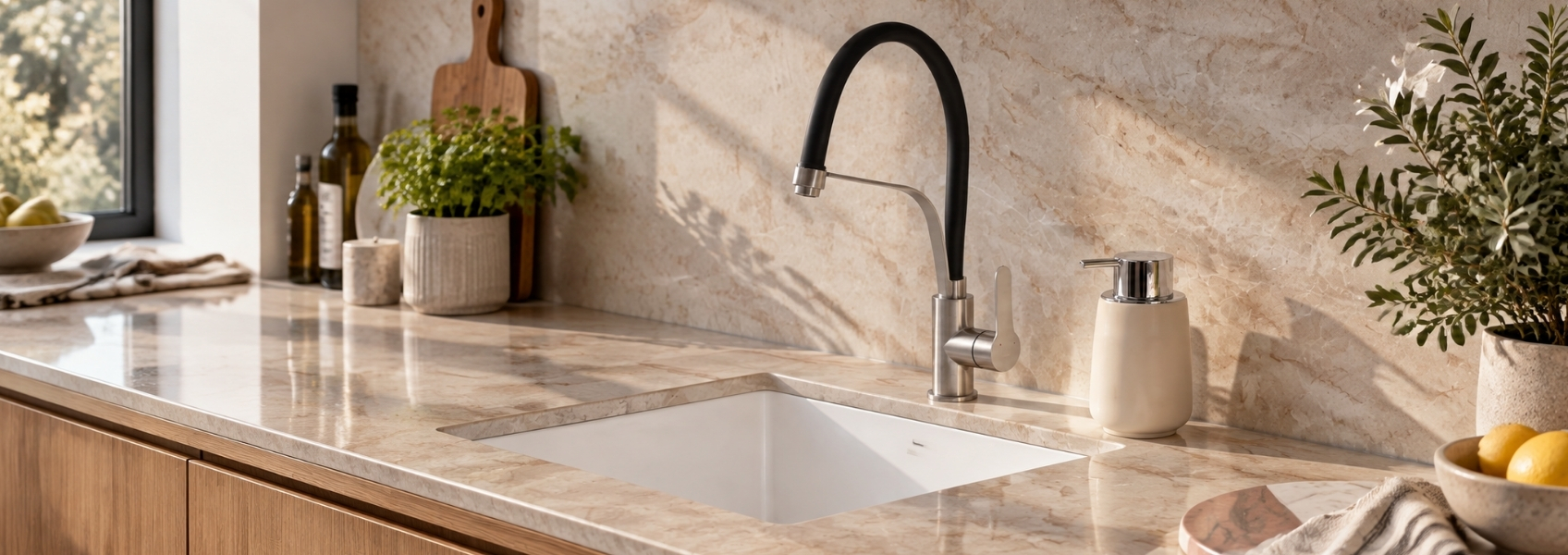
A kitchen tap gets used dozens of times a day, so the wrong choice shows up quickly in everyday jobs like filling a pot or rinsing a pan. The right one depends on how it connects to your sink and plumbing, not just how it looks. This guide walks through the mounting, spout style, hole count and finish decisions before you buy.
In short
How do you choose the right tap for your kitchen sink?
Match the tap to your sink's existing setup first, then choose features around how you actually use the sink. Keep the same mounting type (deck-mounted or wall-mounted) unless you're planning plumbing work, match the tap's connections to your sink's hole count, and pick a spout style with enough clearance for the pots and pans you use most.
- Whether you're keeping or changing the mounting type
- How many holes your sink already has
- The depth of your sink and the size of items you wash
- How much cleaning you're willing to give the finish
Deck-mounted or wall-mounted: how do you decide?
Most kitchen taps are deck-mounted, sitting directly on the sink or worktop, because that's where the supply pipes already run in most kitchens. Switching to a wall-mounted tap means rerouting the hot and cold pipes into the wall behind the sink, which is a plumbing job best done during a full kitchen renovation rather than a simple swap.
- Going from wall-mounted to deck-mounted is usually simpler, since deck-mounted taps only need supply pipes at worktop height, which most kitchens already have
- Going from deck-mounted to wall-mounted means opening up the wall to add or move pipework, so it's rarely worth doing outside a bigger renovation
- Deck-mounted taps are easier to check, reseal or replace, since the connections sit in the open under the sink
- Wall-mounted taps free up worktop space around the sink, but a leak in the wall pipework can go unnoticed until damage shows on tiles or plaster
Which spout type suits your kitchen tasks?
Once the mounting type is settled, the spout style decides how comfortable everyday tasks feel. Kitchen taps are chosen on two separate details: how they're mounted, covered above, and how the spout moves and reaches into the sink.
| Spout style | Best for | What to consider |
|---|---|---|
| Fixed spout | Simple, low-maintenance kitchens | No hose or spray head to wear out, but least flexible for washing large items |
| Pull-out spray | Small or single-bowl sinks | The head extends toward you on a hose for reaching the sink edges |
| Pull-down / gooseneck | Deep sinks, large pots and pans | Tall curved spout gives clearance underneath, but a shallow sink can splash |
| Swivel spout | Double sinks or wide worktops | Rotates side to side, so needs clear space to swing without hitting fittings |
| Low-profile / under-window | Sinks positioned under a low window | Shorter spout keeps the view clear, but reduces clearance for tall pots |
Most single-bowl taps have a spout reach of around 195-230 mm, positioning the water flow near the centre of the bowl; a double bowl or unusually wide sink needs a longer reach or a swivel spout to cover both sides. Clearance above the sink bed varies by spout style too: a standard spout typically sits around 150-180 mm above the base, while a gooseneck or high-arc spout raises this to roughly 250-320 mm, enough room to fill a tall pot or vase without tilting it under the tap.
Shop now: kitchen taps
Does your kitchen sink have the right tap holes?
Before choosing a tap, check how many holes your sink already has, since this decides which taps will fit without extra work. Most single-lever mixer taps need only one hole, while sinks prepared for a two-handle tap, a separate sprayer, a soap dispenser, or a filtered water tap have two, three or four holes.
A single-hole tap typically needs a deck hole around 35 mm in diameter, while sinks drilled for separate hot and cold handles commonly space the two outer holes about 200 mm apart, with wider spacing up to around 400 mm also used on some sinks.
- More holes than your new tap needs: cover the unused ones with a matching deck plate rather than leaving them open; most tap ranges sell one in the same finish
- Fewer holes than your new tap needs: check whether the sink has scored or marked "knockout" points that a professional can open safely
- Stainless steel sinks can usually have an extra hole added by a professional without much risk
- Stone, composite or ceramic sinks are far more likely to crack if drilled without a marked point, so it's often safer to keep the existing hole count or replace the sink
- Switching from a two-handle tap to a single-lever mixer is straightforward with a deck plate, since it covers the extra holes without any cutting
What extra features are worth choosing for a kitchen tap?
Beyond the spout style, a few added features change how the tap performs day-to-day.
- A spray-to-stream toggle on the pull-out or pull-down head, for switching modes without changing tap
- A boost or pause function for filling large pots more quickly
- A longer hose, useful for double bowls or sinks set away from the wall
- An integrated filtered or boiling water option, which needs its own tap hole or unit fitted under the sink
Which tap finish should you choose?
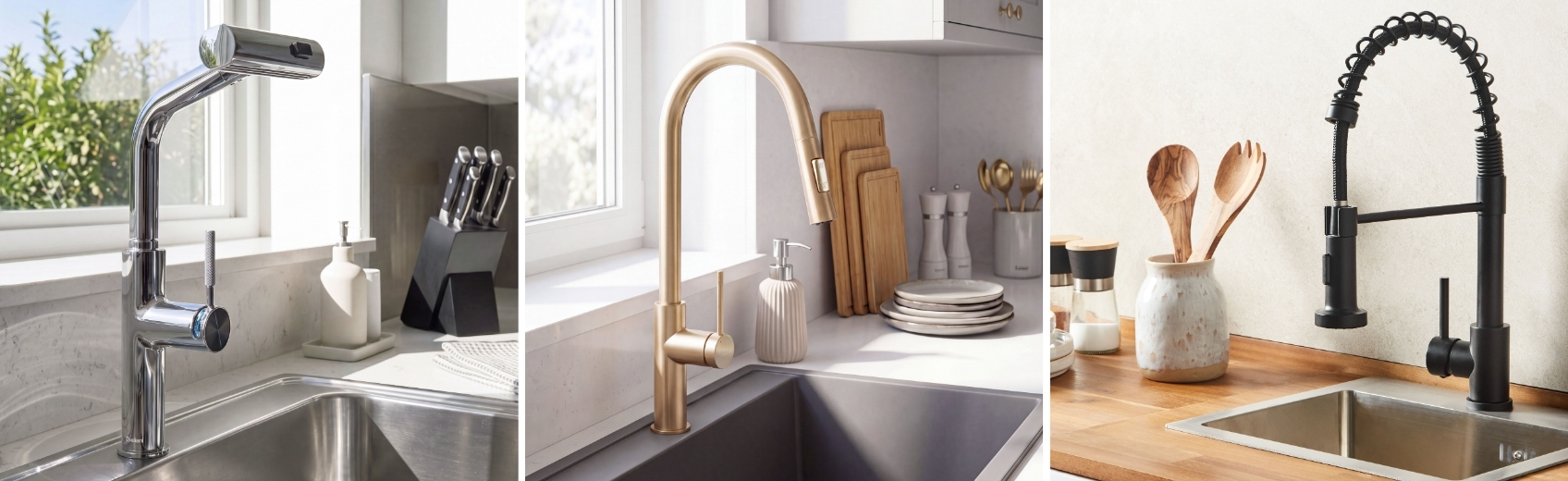
The finish affects daily upkeep as much as looks, and the three main options age quite differently.
| Finish | Cleaning and everyday care | How it ages and fits your style |
|---|---|---|
| Chrome | Wipes clean easily; a vinegar solution removes limescale and watermarks | Resists corrosion well and rarely goes out of style, though the shine needs regular polishing and shows marks sooner than a brushed finish |
| Brushed steel or nickel | Hides fingerprints and watermarks between cleans, so needs less frequent wiping | Ages evenly and keeps its satin look with only occasional care; currently popular and pairs well with stone, wood and matte cabinetry |
| Matt black | Needs wiping several times a week, since watermarks and limescale show clearly on the matte surface | The coating can chip or scuff with heavy daily use; a strongly on-trend look right now, worth weighing against how long you want it to last visually |
A cleaning tip that works on any finish
A plain vinegar and water solution dissolves limescale without damaging the coating. Avoid abrasive pads on brushed or coloured finishes, since they can scratch through the surface layer.
What is inside a kitchen tap?
A mixer tap combines several components that control water flow, temperature and the shape of the water stream. The exact construction and arrangement vary by model.
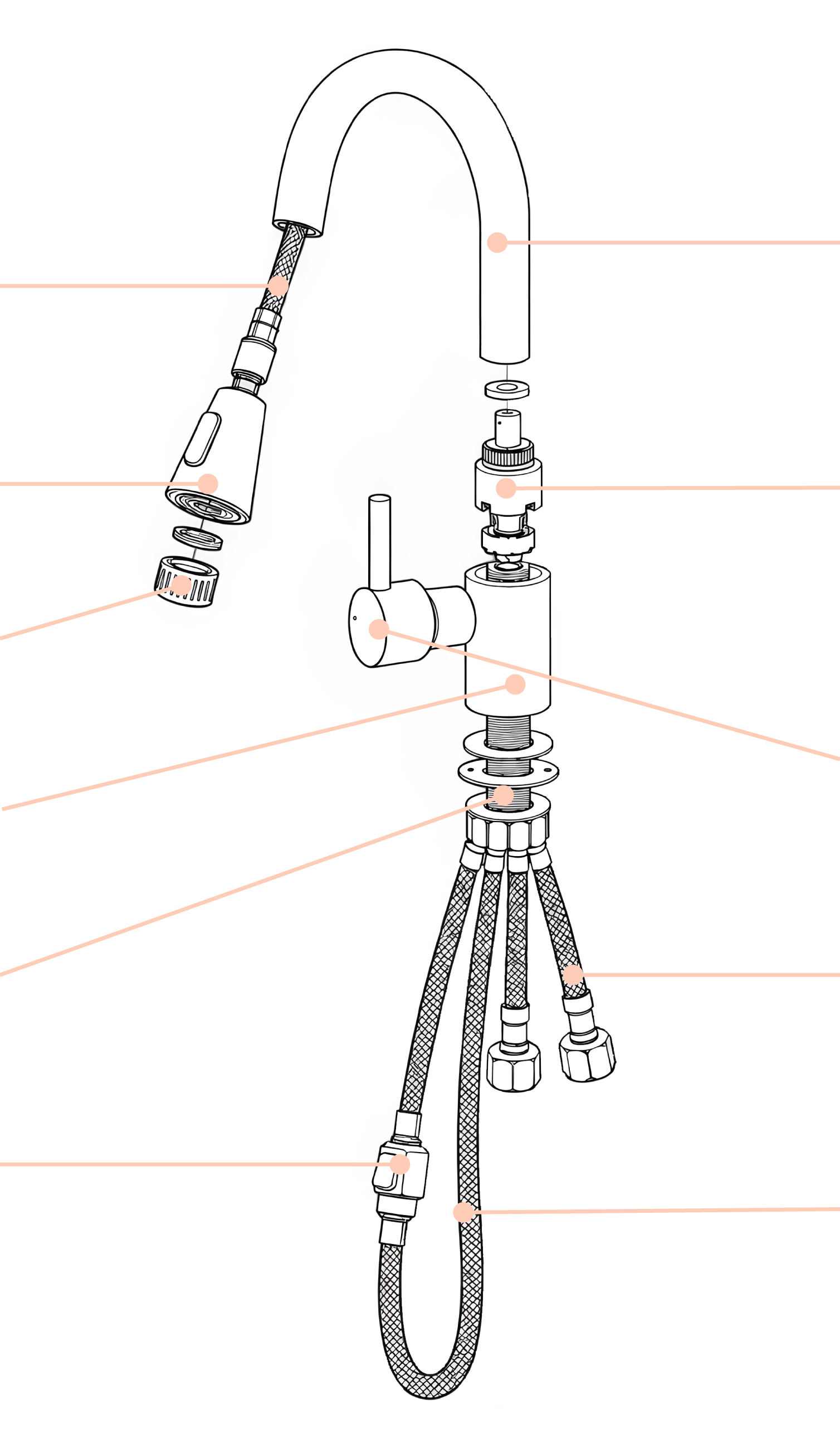
Typical mixer tap construction. Components and arrangement may vary by model.
What to check before buying
Before choosing a kitchen tap, run through the practical checks that decide whether it will actually fit and work well.
- Whether your current tap is deck-mounted or wall-mounted, and whether you're keeping that type
- The number of tap holes in your sink, matched to the new tap's connections
- The spout style that suits your sink depth and the size of items you wash
- The tap height and reach against your sink's dimensions
- A finish chosen for how often you're willing to clean it, not appearance alone
- Whether spare parts like cartridges and aerators are available for the model
Frequently asked questions
Do I need a plumber to fit a new kitchen tap, or can I do it myself?
Swapping a tap for one with the same mounting type and hole count is a job many confident DIYers manage with basic tools once the water is isolated at the valves under the sink. Call a plumber if you're changing the mounting type, adding or removing holes, or connecting a filtered or boiling water unit, since these involve new pipework or electrics.
What minimum water pressure does a kitchen tap need to work properly?
Most mixer taps need a minimum of around 0.5 to 1 bar and perform best between roughly 1 and 5 bar. Gravity-fed systems with a cold water tank in the loft can supply as little as 0.1 to 0.5 bar, so check a tap's minimum pressure rating against your system, especially for pull-out or feature-rich models, which sometimes need a higher minimum of around 2 bar.
Will a taller or gooseneck tap still fit if there's a window or cabinet above the sink?
Measure the gap between the worktop and the window sill or cabinet above the sink before choosing one, since tall and gooseneck taps commonly stand around 300 to 400 mm in total height. If the gap is tight, a standard or low-profile spout keeps clearance for opening the window or cabinet door, even though it gives less room for filling tall pots.
How long should a kitchen tap last, and when should you repair rather than replace it?
A dripping or stiff lever is usually a worn cartridge, which most taps let you replace without swapping the whole fitting. Replace the tap itself once leaks come from the body, the finish is pitted or flaking, or spare cartridges are no longer available for that model.
Why has my tap's water flow become weaker or started splashing?
This is usually limescale building up inside the aerator at the tip of the spout. It unscrews by hand or with pliers, so you can clean it in a descaling solution or fit a replacement without changing the whole tap.
Can I add a filtered water tap to my existing kitchen sink?
Only if your sink has a spare pre-drilled or scored hole, or there is room to add one safely, which depends on the sink material. Stainless steel sinks can often be drilled by a professional, while stone or composite sinks are harder to modify safely.
