
 Free Delivery & Return
 365-Day Returns
 10 Million Happy Customers
 500,000 Products in Stock

How to Choose the Right Height-Adjustable Desk for Your Workspace
Reviewed by the Beliani Content Team · Updated November 2026
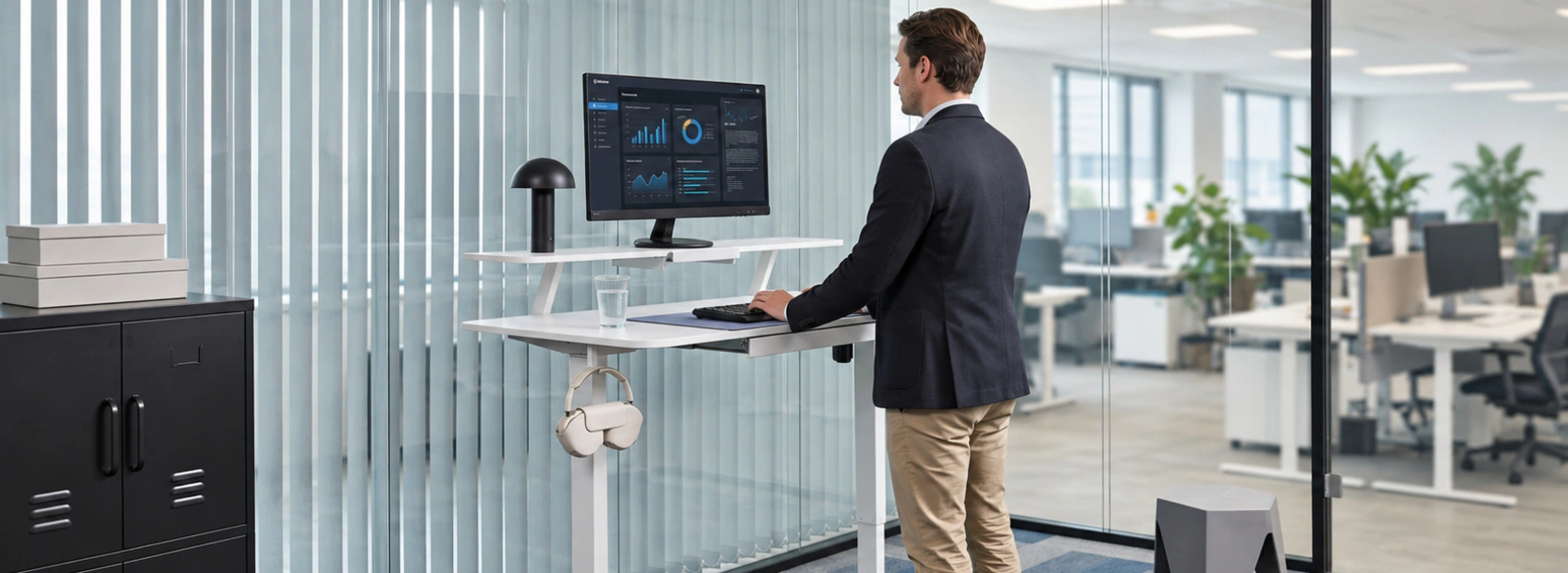
A desk fixed at one height makes your body adapt to the furniture, and the effects can build up over time: tight shoulders, a stiff neck, an aching lower back by the end of the day. A height-adjustable desk removes that trade-off by letting you match the worktop to your own body, and to change position whenever you need to. This guide covers how much adjustment you actually need, which mechanism suits your routine, and what to check before you buy.
In short
Is a height-adjustable desk worth it?
Yes, if you spend more than a few hours a day at a desk. Alternating between sitting and standing lets you break up long spells in one position and build up gradually towards a couple of hours of standing and light movement across the working day, which a fixed-height desk simply can't offer. The real benefit is the ability to change position without interrupting your work, rather than any single "correct" height.
- How many hours a day you're actually desk-bound
- Whether the desk will be shared by more than one person
- Whether you have a power socket within reach for an electric mechanism
What is a height-adjustable desk, and how does it differ from a fixed desk?
A height-adjustable desk has a worktop mounted on a frame that moves up and down, either by an electric motor or a hand-turned crank. Instead of buying furniture built for an average body, you set the surface at the height that suits yours, and adjust it again whenever you want to switch from sitting to standing.
Switch between the two positions to see the same desk at sitting and standing height.
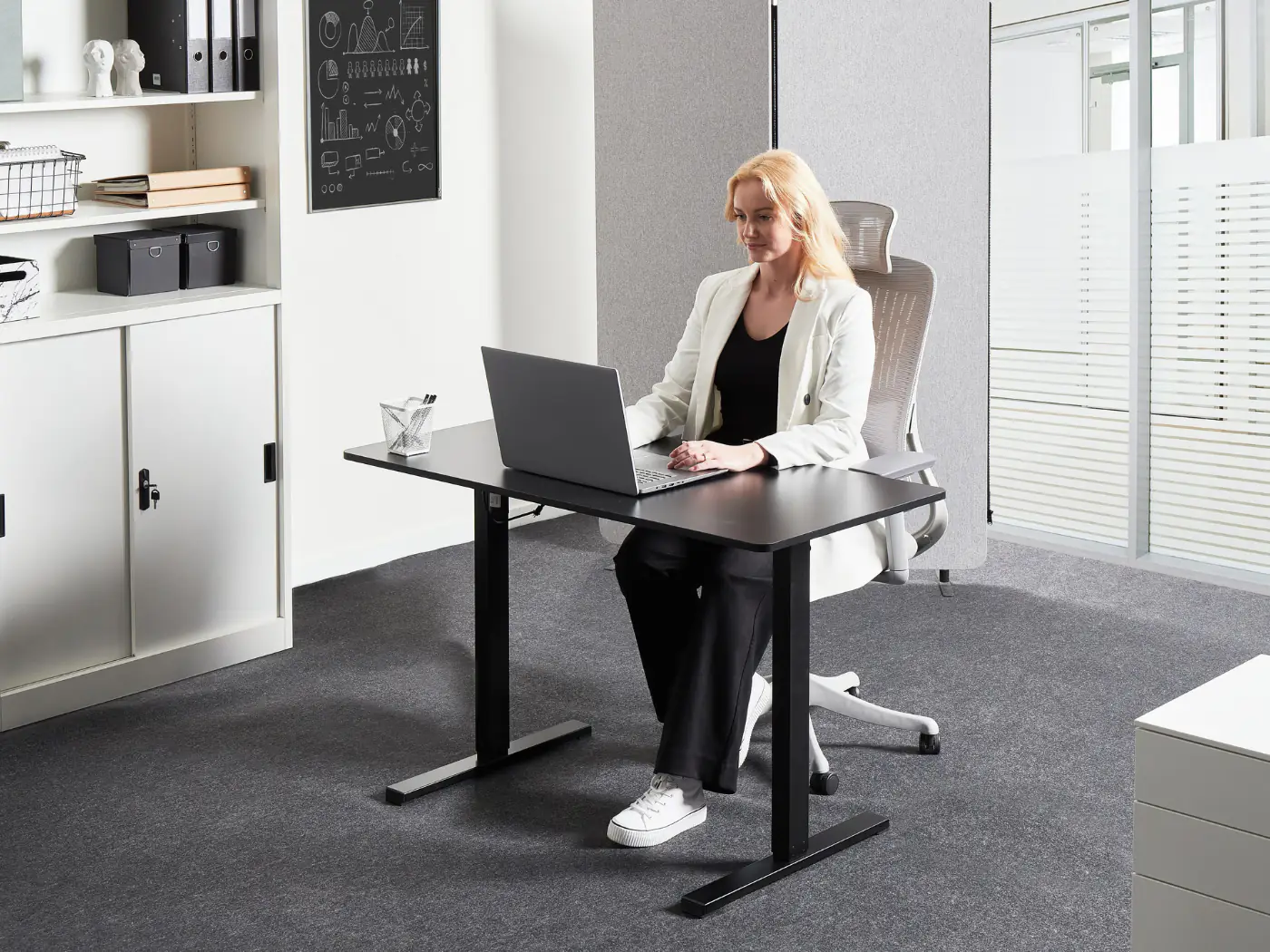
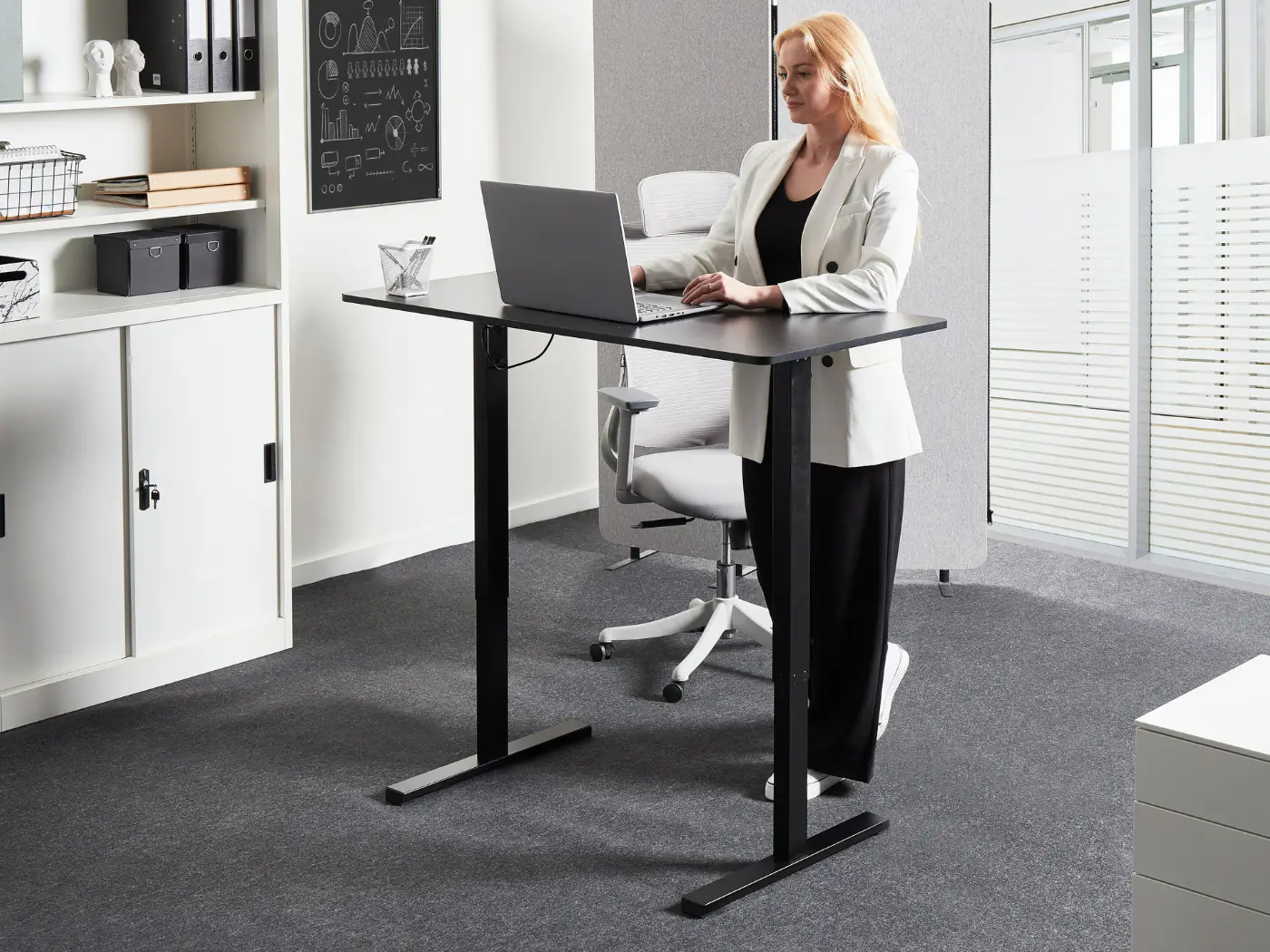
Why choose a height-adjustable desk over a fixed one?
Standard desks are built for an average body, so a fixed height suits some people better than others. A height-adjustable desk changes a few things:
- Fits your body: you set the worktop at the height that suits you, rather than adapting to a desk built for an average person
- Easier changes of position: you can switch between sitting and standing without interrupting your work, which many people find more comfortable over a long day
- Works for different people: the desk can be reset to suit whoever is using it
Electric or manual: which adjustment type suits you?
Not sure which to choose? Answer three quick questions.
How often will you change between sitting and standing?
Will more than one person use the desk?
Is there a power socket within reach of the desk?
Electric is likely the better fit. Memory presets let each person recall their own sitting and standing height at the press of a button.
Electric is likely the better fit. A button press makes it easy to change position several times a day.
Either would work. Manual keeps things simple and has fewer parts that can fail, while electric makes each change quicker.
Manual is likely the better fit. It is simple and robust, and the extra effort matters less if you rarely change position.
Manual is likely the better fit. It needs no power socket, so it works wherever you place the desk.
ElectricBest match for you
Motorised, button-operated adjustment
Raises and lowers at the press of a button, usually with height presets you can save and recall instantly. The easiest option if you plan to change position several times a day. Some models also add extras such as a built-in timer or charger.
ManualBest match for you
Crank-operated adjustment
Needs no power socket and has fewer parts that can fail, which keeps the price down. Adjustment takes more effort and time, so it suits anyone who sets a height once or twice a day rather than switching constantly.
Shop now: adjustable desks
What desk height suits your height?
Use this as a starting point, then fine-tune it once you're sitting or standing at the desk.
| Your height | Recommended seated desk height | Recommended standing desk height |
|---|---|---|
| 160-170 cm | 65-70 cm | 98-104 cm |
| 170-180 cm | 70-73 cm | 104-110 cm |
| 180-190 cm | 73-77 cm | 110-116 cm |
| 190 cm and above | 77-82 cm | 116-120 cm |
These ranges are a guide, not a fixed rule. You've got the right height when your forearms rest flat on the desk at a 90° angle, your shoulders are relaxed, and you're not leaning forward to reach the surface. The same 90° check applies once you raise the desk to stand - your elbows should still sit at roughly the same angle. Shoes and arm length make a difference too, so trust the elbow check over the numbers.
Read more: how to pick an office chair
How much should you stand each day?
A gentle target is enough
There's no need to stand for long stretches. A common starting point is around two hours of standing and light movement spread across the working day, building up gradually if it feels comfortable. The point of an adjustable desk is to make small, regular changes of position realistic rather than aiming for one long stretch standing.
Is a height-adjustable desk worth it for home offices and shared desks?
It's one of the more practical upgrades for a home workspace, since it gives you the flexibility to alternate between sitting and standing without needing a second desk. It's also well suited to shared spaces, where different people use the same desk at different times of day - an electric model with memory presets makes switching between users straightforward, since each person recalls their own saved height instead of adjusting the desk from scratch.
Read more: how to arrange a perfect home office
What accessories pair well with a height-adjustable desk?
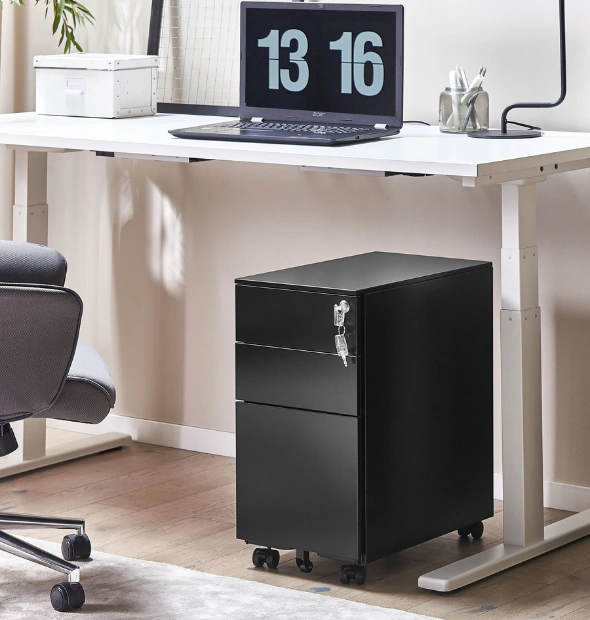
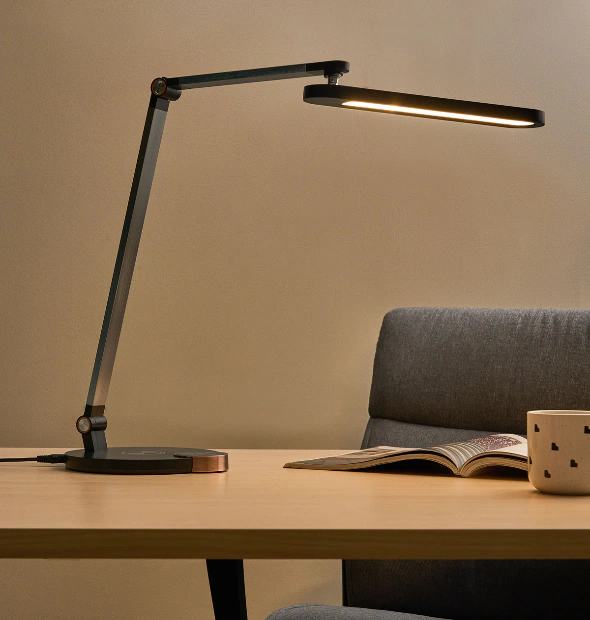
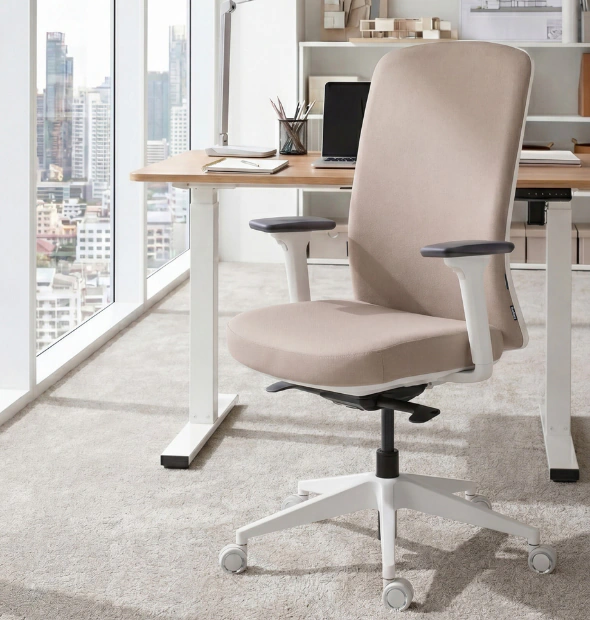
Shop now: products in the pictures
Seating and lighting
Once the desk itself is sorted, a few other pieces make the setup work better day to day:
- Ergonomic office chair - your chair and desk work as a pair. Look for independent seat height adjustment so both can be fine-tuned together.
- Office lighting - can help reduce eye strain over long working hours, especially near a screen.
Read more: how to find a professional office chair for your workspace
Privacy and storage
- Privacy screen or room divider - useful in open-plan spaces when you need to focus without distractions.
- Lockable filing cabinet or mobile pedestal - keeps the desk surface clear and documents secure.
Shop now: office chairs, screens and room dividers, office lighting and office cabinets
What to check before buying a height-adjustable desk
Work through these before you commit to a specific model:
- The height range covers both your seated elbow height and your standing elbow height, not just one
- Electric motor or manual crank matches how often you'll realistically switch position during the day
- The desktop size fits your monitor setup and leaves room to move your arms freely
- The base stays stable and doesn't wobble when the desk is raised to full height
- A power socket is within reach if you're buying an electric mechanism
- Your desk chair's seat height adjusts independently, so it still works with the desk at any setting
Frequently asked questions
Is standing all day better than sitting all day?
No. Standing continuously can bring its own problems, such as leg fatigue and lower back strain, so the goal is to alternate rather than to stand permanently. A height-adjustable desk is useful precisely because it lets you move between the two.
Can two people share the same height-adjustable desk?
Yes, particularly with an electric desk that has memory height presets. Each person can save their own sitting and standing height and recall it at the press of a button, rather than adjusting the desk by eye every time.
Do electric height-adjustable desks need a dedicated power socket?
Yes, an electric desk plugs into a standard power socket near the desk. If you don't have one within reach, a manual crank desk gives you the same height adjustment without needing power at all.
Can I buy just the adjustable frame and add my own desktop?
Many height-adjustable desks are sold as the frame only, without a worktop, so this is worth checking on the product listing before you buy if you already have a desktop you want to keep using.
Will a height-adjustable desk wobble at full height?
A well-built frame with a wide base and sturdy legs stays stable at any height, but stability varies between models. Check for a reinforced or dual-motor frame if steadiness at full extension matters to you.
